Saturday, December 18, 2010

Internship application period extended until January 15, 2011


We are still looking for the right person for the next internship, starting April 1, 2011.

The application deadline has been extended until January 15, 2011.

Monday, December 13, 2010

Sen-no-sen arimasen


Peter Here,

This week we have been working on 'Sen-no-Sen', which is essentially the interrupting of your opponent's intention to attack just before he starts it.

Not wanting to sugar coat it or anything, but I don't think anyone in Shiramizu could be worse at this than I am. It's just something that doesn't happen at the moment as I think too much about fighting options, what I could or couldn't do. 'hmm, maybe I could.. Oh dang, too late- he's just scored.'

So because of that I was really trying to focus in on the training routines this week.

One of the most basic (and most often used) techniques is the gyakuzuki counter punch. Especially in the typically more linear style of Japanese karate fighting, the punch is launched just before the opponent begins his technique so it lands first, but with the opponent's aggressive momentum helping your cause. In Japan, I've also learned that dropping the body level can also help with the speed of the hip rotation with the added bonus of getting your head out of danger. This works as long as you keep your posture upright, as if you lean forward 'into' your counter you run a high risk of being hit harder by the opponent. What I need to focus on however is that I keep my posture upright in the counter and that the distancing between myself and the opponent is correct.


A drill is set with both attacker and counter-attacker in an uncomfortably close mawai (distance), with the attacker trying to launch a front jab without 'telegraphing' movement (telegraphing is preparing the shot in a way that gives away your intention to attack, such as pulling back the punching arm or excessive bending of the knees). The counter attacker must 'sense' when this is about to happen, then launch and land the counter punch.

As I said before, this is very difficult for me, so I ended up falling over a couple of times being overly twitchy or not registering the attack enough. It will take me a while to get this, but I am hoping I will have improved enough for the next tournament in January.

Arakawa Sensei also says this is good practice for me as I kick too much. Not only that, but it's a good sign that I have run out of an attack plan so I try and earn the larger points. Because of this, it's been really good to try and use my hands more to improve my armory. My reach is ok, so it is the timing and confidence that I need to work on.

Practise, practise, practise.

Kata Focus: Seishan Problems

Peter here,

This week's kata problem focus has been on Seishan, particularly the shiko-dachi section.

Intern alumni Louise Fisk showing good form!

Having finally got my shiko-dachi to a less embarrassing level, I'm now working on the kick-through-to-gedan notsukkomi part. Typically for me, the problem is with keeping the centre line when kicking out and because of this I tend to thrust too much and 'fall into' the no-tsukkomi position rather than pull back and quickly place my foot down into kamae. Uehara Sensei has consistently lamented this part of my kata, so I have been determined to put it right.

In my Training diary, I try and keep as much of it in diagrams as possible as it visually reminds me what I have to do (they aren't technically excellent sketches as they more of a visual prod than figurative examples), so the example below is the difference in the position that I should be in (top, far right) and the position I have been in so far (bottom, far right).

The important part is to stop the hips thrusting out, as you can't then return to a safe position before placing your next stance.


The problem is that I use the momentum of the thrust to get the kick out as quickly as possible, but sacrifice form because of it. Richard has pointed out to me in the past that I tend to 'scoop' my kicks too much (this happens in Chinto as well) and it slows me down, so I've been working on this too. The unfortunate part of this is that now I'm not in the proper body position when I place down in no-tsukkomi- my body faces forward instead of turned. However I'm sure with enough practise the creases will be ironed out!

Saturday, December 4, 2010

Fear in the place of Form


Peter Here;

Last week I was kicked hard in the mouth during training, and it split my lips open. the force wasn't intended, and the risk is part of the chances you take when you practise a contact sport or budo art like Karate. In fact, I am actually quite happy it happened, and I'll explain why.

The simple thing is, I have been afraid of getting hit and it tends to show in my form whenever I feel I am facing a stronger opponent. Arakawa Sensei notes that my weight is on my back foot and I turn my head far too much (he even penalises me in training because of it), and the fear ruins my kamae and speed.

But what is it about being hit that I am afraid of? Part of it is that I am afraid of the damage it could cause. I have been injured heavily a couple of times before but then I have to accept that this can happen to anyone who does this kind of sport. But the main reason is just the fear of how much it could hurt at the time of impact.

The problem with fear is that it makes a wonderful magnifying glass, taking any worry or concern and then multiplying it many times until it becomes irrational. One hit could really hurt a lot, my fear told me.

Particularly with lower grades and members who 'cross train' in popular full-contact sports in the UK, people are more likely to hit harder than karate students in Japan. This could be due to physiological reasons (they are generally bigger people), lack of controlled contact training, or just the belief that other students can 'take the hits' and that it is character building (this kind of 'Kibishi' or 'hard training' has it's place, but there must always be control, particularly in WKF Sport Karate- it is not MMA or Kyokushinkai)

So, when I was hit in the mouth, although it hurt a lot it didn't hurt as much as I was worried it could. The magnifying glass was, if not broken, at least a little chipped.

Now I can focus more on my form for the next tournament!

Tuesday, November 30, 2010

It's beginning to look a lot like Christmas...


Peter Here,

I love Christmas. It's my favourite time of the year without any doubt, even though I am more of a warm weather person. But while Japan seems to be treating me well by not subjecting me to freezing weather as yet, I have been curious to find out how Japanese people and families celebrate this time of year, as they do have the festive day- but not the Christian historical background.

While eating together at the Flying Garden after training on Wednesday, I asked Arakawa Sensei and Suzuki Sensei how they spend their Christmas, and what they eat on the day. It turns out that Japan's Christmas is more focused on couples and young children than in the West, but they still love eating the Christmas chicken and Christmas Cake (Strawberry Sponge Cake to be precise). Some people have the occasional potatoes and some trimmings, but both Sensei looked a little taken back when I explained to them exactly *how* much a regular UK family chomps through on the big day (and subsequent days too). I also let them know that I wasn't a particular fan of Christmas Pudding (although I had to describe it as 'cake', as pudding is completely different here), because it was a little to rich for me. They assured me that the Japanese Christmas Cake is much nicer, so I look forward to trying that out!

So, the Japanese celebrate Christmas in purely a commercial form, but it is intriguing to see how similar it still is to the way we celebrate at home. I myself am 'agnostic' so Christmas doesn't hold any religious meaning for me. However, it must be said that the traditions brought over (the tree, decorations, big feast, giving of gifts) are more in line of the pagan winter festival than the traditions left out (carol services, Nativity plays, midnight mass, etc.).

One thing that can be said though- Japanese LOVE decorations. Some restaurants are already sparkling with tinsel, some houses are already ramping up their electricity bill with house lights, and generally the shops are all celebrating like they do in the UK; by trying to sell things!

Monday, November 29, 2010

Full Day Ahead: Aikido, Gardens and Odaiba


Peter Here,

One of the many things I wanted to do while I was in Japan was to try another martial art, preferably a traditional one. Despite Oinuma-san's suggestion that I try sumo (I'm NOT fat!!), my friend Makiko is a 1st Kyu in Aikikai Aikido. As her dojo was in Kasukabe, she suggested that I come along for a session and see what I think. Aikikai Aikido is run by Haruyoshi Horikoshi (堀越春芳) Sensei, 7th dan, who has travelled to countries such as USA, Brazil and Australia teaching Aikido. We had a wonderful conversation prior to training, and his english, although a bit limited comparing to Arakawa Sensei, was eloquent, friendly and very polite. The website for the dojo is here (japanese only).

I had a great time, and it was enlightening to see how different and similar the principles are. Aiumi-ashi is used, as is Irimi, but other steps are introduced too, controlling your opponent by seizing their grab and turning your body to give you the more powerful position. They also practised Jo and Bokken Kihon, which was a first for me.

I also went there with a view to seeing what I could use for my karate practice; the slower pace meant I can be more aware of how my body is moving, so that I may speed that up for the more explosive karate movements. Center-line, balance and natural movement are all central concepts of both styles so I can see a happy marriage between the two.

Horikoshi Sensei was very welcoming, and I managed to introduce myself to everyone properly and have a little conversation too. I look forward to going there again!

After class, Makiko and I went on a sightseeing spree. After not seeing much of the Hamarikyu gardens last week with Oinuma-san I wanted to go back there again and explore it more. I was very glad I did, it is a splendid garden and incredibly beautiful; all the pictures in my camera couldn't do it justice.


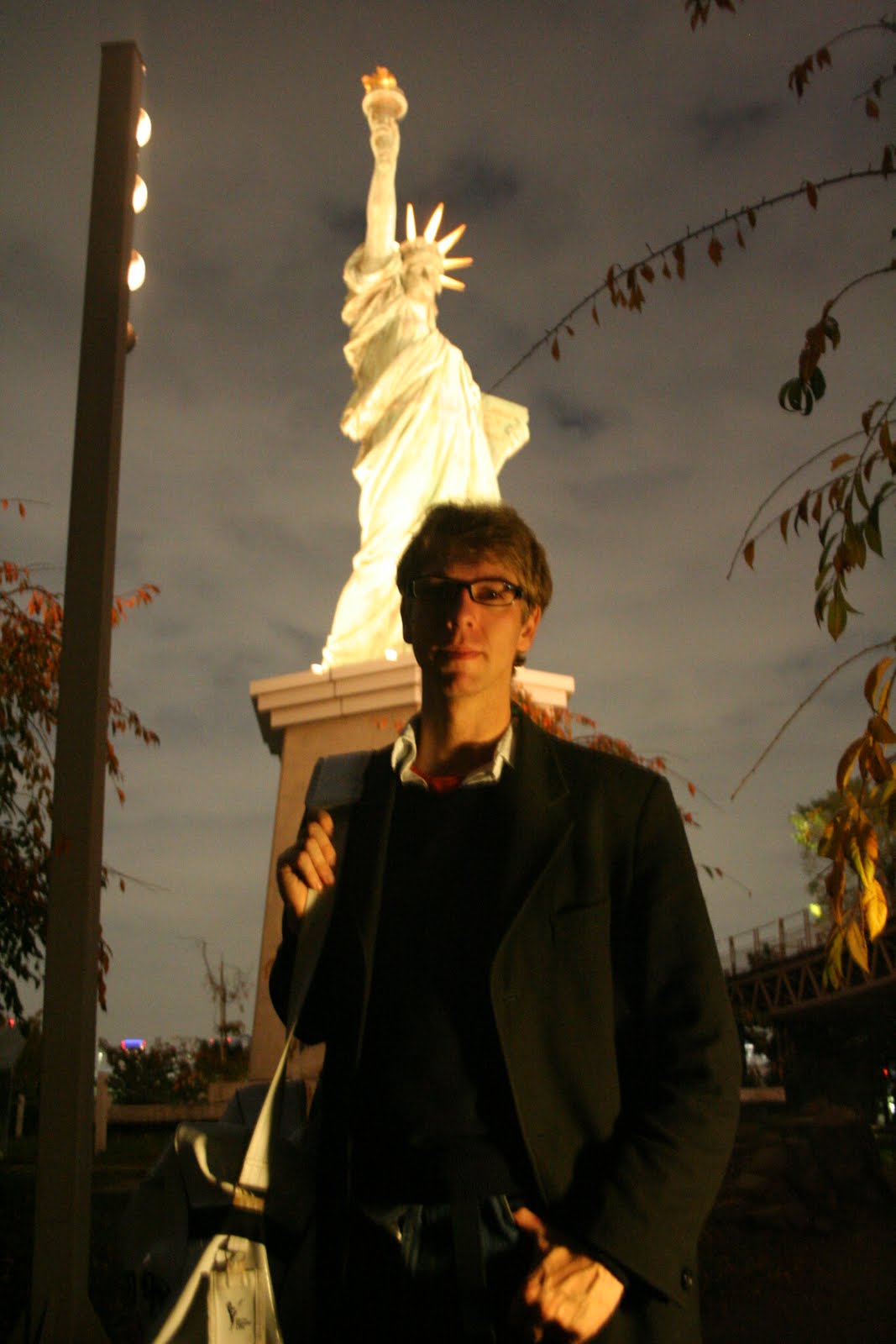
After wandering around the gardens for two hours, we then headed for Odaiba. Odaiba, once a man-made fort island made in the Edo era, is a fantastic shopping and entertainment district. Heavily westernised, the view and buildings would not look out of place in America. Indeed, there is even a minature Statue of Liberty there!


However, the peace and quiet, and the walk along the man-made beach always contains the uniquely Japanese sense of safety in the city. More information on Odaiba can be found here: http://www.japan-guide.com/e/e3008.html


We took in the sights (including a Christmas aquarium!), took a lot of pictures then headed back home on the Spacia train from Asakusa (an express train more like the type in England but better run and more relaxing, which you pay an additional fee to board on top of the distance fare). After all that walking we thought we deserved a little comfort!

Sunday, November 28, 2010

An international Evening: Sakayuri Sensei's international party


Peter Here,

I always love meeting new people from many different countries and backgrounds, so when Arakawa Sensei told me about Sakayuri's International Party on Saturday, November 20th, I leapt at the chance. It was a group of 9 people including me, but only one other was a native English speaker; the rest were from Taiwan and China. This meant that the only way to communicate was through Japanese!

We started off slowly, a mixture of shyness and unfamiliarity slowing the conversation a little, but after a quick trip to the local Supermarket (Mami-mart, or 'まみマ-ト') for supplies and alcohol, we started to loosen up a little and soon everyone was happily talking.


People were a mixture of university graduates, undergraduates and language students on a work programme, and it was interesting to hear how different everyone's story was to mine; after hearing many people give their reasons to why they are in Japan it always strikes me as how unique and special the internship is.

Eikaiwa (English Conversation) teachers appear to come to Japan because they have little keeping them in their own, or the lure of the high-paid teaching tempts them in. But I see that a lot of these people don't have anything to aim for, to try and attain here. University or language study students do have that, but their life is experienced more in a microcosm inside Japan, rather than being given the ability to be more involved in Japanese Life. The Internship offers a goal in itself and gives plenty of opportunity to achieve personal targets, such as tournament results or grading, but further to this it is all done in a totally open and supportive atmosphere. You are involved in Japan, not closed off from it, which helps make new friends and immerse yourself in the culture. It truly is something great.


Because many of the guests were with home stay families in nearby Miyashiro City the party didn't run too late, but enough was drunk and eaten to make sure everyone had a great time and left full of food and conversation!