Monday, May 31, 2010

Shiramizu Timetable 2010


Louise here,

This is the new Shiramizu timetable for this year starting in April. For those who don't read Japanese, I'll give a bit of an explanation.

The kanji characters in the blue boxes down the left-hand side are the days of the week, Monday to Saturday. The light orange line on each day shows the classes at the main dojo, while the white lines show the classes at the branch dojos.

The teachers for each class are indicated by the single kanji in the small boxes on each class period. These kanji are the first characters of each instructor's name, the key for which is at the top of the timetable. There, from left to right, is Takamasa Arakawa sensei 荒川先生, Hiroyuki Uehara sensei 上原先生, Bunmei Suzuki sensei 鈴木先生, Hitoshi Kikuchi sensei 菊地先生, Takamasa Iwasaki sensei 岩崎先生, Yukiko Yamazaki sensei 山崎先生, Noriko Yoshihara sensei 吉原先生 and the karate intern 研修生. (I help with a Friday class from 6 to 7:30 pm, and Pete will take this over when he comes.)

L classes are for grades 1-3 of elementary school; M classes are for grades 3-5 of elementary school; H classes are for grades 4-6 of elementary school; the J class is for grade 6 of elementary school and junior high school students; and A classes are for junior high school students to adults.

High performance classes are on Friday (A class, from 7:30 pm) and Saturday (B class, from 10:30 am). The A class is for 3rd Kyu and above of 5th grade elementary school to senior high school students. The B class is for 6th Kyu and above of grades 1-4 of elementary school. High performance students train eight times a month in normal classes plus 2-3 times a month in the high performance classes.

The morning adults' class has actually been moved to Wednesday morning, as it was last year. Note also that on Monday morning there is an aerobics class, on Tuesday morning a yoga circle, and on Thursday (now in the morning), a hula dance circle that also use the main dojo.

While there are only three adult classes per week this year, we can also join the junior high school classes for more training, and I also go to train at Guseikai in Tokyo with Takagi sensei on Tuesday and Sunday nights.

Wednesday, May 19, 2010

Takeuchi Ryu Jujutsu

Louise here,

At the International Budo Seminar we attended in April, I met Anthony Abry, who does Takeuchi Ryu jujutsu. On Saturday morning, he invited me to Nakano in Tokyo, to one of the dojos he trains at, to see what they do.

It seems to me that they do everything. Takeuchi Ryu is one of the oldest koyru martial arts in Japan, founded in 1532 by Takenouchi Hisamori. I suggest you read the Wikipedia article about Takenouchi Ryu, where it is explained better than I can, especially the story about the beginnings of the art. That story explains why the basis of Takeuchi Ryu is the use of a knife or dagger, called kogusoku. It is also meant to be carried out in armour, so the target areas are mostly the weak points like the armpit and joints.

At the training practice, we did ukemi (breakfalls and rolls), some joint-locking two-person kata, then practice with long bo. It was the first time I've practiced with a bo, so I had to concentrate very hard. It was fun finding new muscles too: my arms remembered the bo for two or three days afterward. During free practice after class, I also saw people practicing naginata, iaijutsu, shorter bo, and grappling on the floor. Anthony explained that Takeuchi Ryu is a complete art, including both weaponless techniques and many kinds of weapons. I only wish I'd taken some photos!

Sunday, May 16, 2010

Nihon jin?


Hello Kyoto!

Erica here.

Sorry for the large gap between now and our last post. Golden Week has come and gone and with only a month left we've been running around trying to cram as much fun in as possible before we leave!

During my time off in Golden Week, my friend Stephanie came to visit and travel Japan with me. Many foreigners living in Japan have said that sometimes they receive quite a bit attention unwanted attention such as being stared at on the train. I have never had this experience because I look Japanese and just blend right in. Things only get awkward when random strangers come up to me to ask for directions, which interestingly occurs quite often. I can usually understand what they are saying to me and on rare occasions I even manage to point them in the right direction, but most of the time I resort to saying, "Ano..gomenasai. Wakarimasen. Nihongo wa chotto..." which translations to "Umm..sorry. I don't know. My Japanese is a little..." At which point you see the shock register on their face.

But during Golden Week, I got a taste of what being stared at because I'm a foreigner feels like and here's how it happened. My friend Stephanie, like me is Chinese - Canadian so while we were on our adventures, we looked like 2 Japanese girls on vacation. This held up until we started talking to each other and whether we were on the train, in a restaurant or on the street people would blatantly stare at us. Some even had their mouth hanging open. I kid you not. I won't say everyone had this kind of reaction, some glanced at us curiously a couple times as if trying to confirm we were speaking English. I suppose it is a strange sight to see 2 people you thought were Japanese, in Japan, speaking English rapidly with each other. You don't really expect that to happen and when it does I suppose it is quite shocking and you can't help, but stare. It was interesting to see these reactions, although by the end of our trip we were feeling a little tired of being stared at every time we spoke with each other. But now that my friend has left, I can go back to blending in on the train everyday. That is until someone asks me for directions =_='

Some pictures from our adventures!


Stephanie and I at Kinkakuji

Osaka Castle!

Wednesday, April 14, 2010

Sakura!

Erica here.

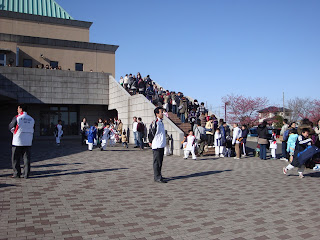
This past week, cherry blossoms all over Tokyo were in full bloom. Two weekends ago, I went hanami-ing? (is that the right term?) The kanji for hanami is 花見. 花 = hana = flower, 見 = miru = to see. I went to Omiya-koen (Omiya park) one day and Kinrin-koen (in Sugito) the next day with Yoshinhara Sensei.

We have cherry blossoms in Vancouver as well, but it is nothing compared to Japan.

At Omiyakoen, a big area of the park was filled with sakura trees and in every which direction you looked was a canvas of cherry blossoms. It was breath taking and definitely a must-see if you visit Japan around this time.

Omiya-koen

Then last Saturday after karate class, two very nice guys from the dojo (Okano-san and Hirai-san) took Louise and I to Gongendo in Satte city to view cherry blossoms at night. This is apparently called yozakura. Gongendo is popular site to see sakura because it has a 1km path with cherry blossoms on either side of it. At night, there are flood lights that shine on them so they can be seen. I was told that the yozakura is for all the people who work during the day and don't have a chance to go see the cherry blossoms. So after work, when it is dark out, they light up popular areas with sakura so that people can enjoy at anytime of the day.

Seeing cherry blossoms at night is completely different than during the day. It might be the romantic/mysterious aura that is given off by the contrast of dark and light and something so beautiful. It was a very memorable experience!

Yozakura at Gongendo

Group picture!
From left to right: Okano-san, Hirai-san, Erica, Louise, Louise's friend Toshiki

Monday, April 12, 2010

11th Shiramizu Taikai

Louise here,

On the day Erica had her shodan test in Chiba, I went to the Shiramizu club tournament. All the members of Shiramizu younger than senior high school were entered, which, including a few members from other closely related clubs, totaled 366 competitors.

Lining up half an hour before the hall opened

In the first rounds in each age group, the kids had to do kata and then the final rounds were kumite (the kindergarten kids did kihon then kata). I thought this was an interesting way to organize it, so they had to be good at both to win a medal.

(Editor's note # 1; Kata was judged using a ballroom dance judging style. The young athletes in groups of 6-8 did the same kata as many times as possible within 3 minutes while the judges walked around scoring them best to worst. At the end of 3 minutes, the judges would meet to determine the best 2-4 to go onto the next round. It was a great way for judges to see the true abilities of the athletes, and it allowed the athletes to perform much more than if they had just one round of one kata to do, especially athletes who didn't go past the first round.

Note #2: The gym used was a performance auditorium which held hundreds of tiered, cushioned seats and the floor stage was big enough for 3 rings. This allowed families to see the tournament quite well while also being somewhat more comfortable during the whole day compared to a normal arena or gym space.)

At lunchtime and in the early afternoon there were demonstrations by the adults and senior high school students, along with the traditional 'Karate man' demonstration. From what I gather, this happens along the same lines every year, including the intern for that year. What a pity Erica wasn't there to be embarrassed with me. Choreographed by Okano san, the story this year was that three bad guys try to take over the tournament, I fight them off, get shot with an evil medicine bullet and become bad, five karate man heroes appear wearing hero suits, we all fight, I become good again, the good guys win and live happily ever after.

Victory pose

At the end of the tournament after the finals had been held, the adult class demonstrated board-breaking. That was the first time I'd done it, and it was very very fun.

Breaking those boards

Friday, April 9, 2010

Kimonos!!


This week, Louise and I were invited to have lunch and try on kimonos by some of the ladies who rent out the dojo once a week for hula dancing! First we were roped into doing some hula dancing. It was slow paced in general, but a little difficult to follow since it was our first time and didn't know any of the movements. After about 30 minutes of hula dancing, we commenced the fitting of kimonos!! There were 4 ladies present so we each had 2 of them to help us.

I first tried on a kimono that can be worn year round. However, before putting on the actual kimono, a towel was wrapped then tied to my waist for a 'small waist look'. Then undergarments were put on and then the actual kimono went on top. There were lots of ropes tied here and there before the obi (belt) was wrapped around. They showed me how to tie it, but I have forgotten now =_='

The second one I tried on was a summer kimono. The fabric is lighter and the design is more intricate. The obi on this one was far more complex than the last one because it was a lot bigger. They didn't show me how to do this one, but they spent a good 10 minutes on it.

After trying on a couple more we decided to have lunch. There was so much food that I was glad we were eating after we had tried on the kimonos and that we weren't eating IN the kimonos because it was a little bit difficult to breath in them =p

Louise being dressed in a summer kimono

The huge bow on summer kimonos
(This type of bow is worn on single women. Married women have a different type of knot at the back)

kimono #1

kimono #2

Louise in a year round kimono

One of the ladies modeling a child's kimono for us =)

At the end, the ladies gave us the kimonos as gifts! Thank you very much!! We love them!!!

Monday, March 29, 2010

Shodan shinsa - black belt test!

Erica receiving her black belt from Arakawa Sensei in the Shiramizu dojo several days after the shodan test. (check out the pink Japanese tabi socks...!)


Erica here.

Last Monday, the 22nd of March, about 15 Shiramizu members and myself attended the shodan test (Wadokai Kanto Area Dan Examination, or in Japanese, Wadokai Kanto-chiku Shodan Shinsa, 和道会 関東地区 昇段審査) in Chiba. Because the Shiramizu tournament was on the same day, we participated in the opening ceremony that morning first before rushing off to the exam.

Kikuchi Sensei accompanied us that day and we arrived just in time for the pre-test seminar. There were about 90 people in total I would guess. About 70 were there to try for their shodan (1st degree) and most of them were kids and teens along with a few university students. I think I may have been the oldest person in the shodan category =_=' The other 20 were candidates for nidan and sandan (2nd and 3rd degree) and most of them were adults.

We were all seated on the gym floor and called up 5 at a time to do standing kihon and ido kihon. After a short break we were called up again to do 1 kata (for the shodan candidates) or 2 (for the nidan and sandan candidates). After another break, we were asked to do kihon kumite and free kumite right after that. Now all this may not sound very difficult and in essence it shouldn't be because we should have trained so much that it comes to us naturally when we are up there. The thing that got me the most that day were my nerves. I couldn't even think about what I was doing because I just blanked out. Fortunately, my muscle memory kicked in and carried me through.

It took about 4 hours to get through everyone and in reality we only spent about 5 or 6 minutes in total up there in front of the examiners and everyone else. At the very end, results were announced. Most shodan candidates passed, but only a few of the nidan and sandan candidates passed. Of course, all the Shiramizu members received a pass! It was a happy day for all, except for the fact that we had to miss the Shiramizu tournament to be at the exam =(

Sorry, I was too distracted to take pictures..so there are none for this post. Gomenasai!

(Editor's note: We're of course very happy Erica passed her shodan in Japan! This is exactly what we're hoping for from all the interns each year, to try hard continuously to the point they have developed to the next level in their Karate, and then they can formally realize that improvement by passing a milestone event here like achieving their next dan rank! Just aiming to pass the next dan test only is not the goal, but more a recognition that the efforts they put into their daily training are paying off.)