Monday, July 11, 2011

More Than One Way to Learn

Erica here!

One of the lovely things about the Shiramizu dojo is the variety of instruction available. The diversity of the Sensei in terms of experience and instruction style insures that I receive a variety of perspectives on my progress as I train. At this point, I've interacted with some Sensei more than others, but I'll just use this blog to talk about my experiences with a few of them.

There are two female instructors who I mentioned before, Yoshihara Sensei and Yamazaki Sensei. These ladies motivate me so much for a variety of reasons.When I first began this journey and everything was new, they really came to my aid in a very basic way: by telling their stories how they both started Karate in their 40s, how they have gotten good enough to teach at Arakawa Sensei's dojo, and how they have done well in various competitions.

On the one hand, it's awesome to know that I'm training under the umbrella of Arakawa Sensei, someone who is internationally recognized for his talent, and who has a room full of medals and awards that signify his exceptional martial arts ability. Learning under someone who is so throughly accomplished makes me feel that I am in good hands as every time I train at Shiramizu.

However, it can be intimidating and difficult to relate to someone who's been immersed in Karate for longer that I've been alive! Therefore, it's easier for me to see Yoshihara Sensei and Yamazaki Sensei as more immediate role models because of their background. Through training everyday, they developed a love and passion for karate, along with great skill. Even though they haven't practiced Karate for decades, they have a spirit of learning, and continual improvement that is thoroughly transparent and contagious, and I'm always energized by their presence and instruction.

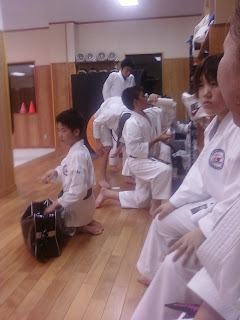
On Sunday, we had a special "girl's only" practice and both Sensei made the experience great for everyone.


Female only Practice! The Dojo certainly smelled different that day :)

Uehara Sensei has also been a great help to me. He is very gentle, but stern in his instruction, and he has really helped me to break down many of the different Kihon. I can repeat a move over and over with him and he will continue to help me correct my mistakes until I gain confidence.

I've also recently begun training with Peter and Richard. While Peter isn't a dojo Sensei of course, I feel I really benefit from the occasional private practices we do together, not only because he speaks English, but he's also incredibly funny when he explains things, which helps me not to take things so seriously. While of course the internship is serious business, I'm also a beginner and he helps me to remember that that's not a bad thing, rather, it is something everyone has to experience to move to the next level. He is definitely encouraging as well, and because he was the former intern, I know that we have some shared experiences which helps me put things into perspective.

Training with Richard is great not only because of his own long and impressive martial arts background but also, due to the fact that I see him once a week, he is able to evaluate the changes in my ability differently than the other Sensei who see me every other day or so. When I train with him, he also gives me great insight into the reasoning behind moves and he helps me to understand what I should be thinking about and what others will be looking for when evaluating my Kihon and Kata.

All this instruction will soon culminate into my first belt test, which will be on July 9th! Last week, there is no formal Karate instruction at Shiramizu, so my preparation will be mostly self-training. I'm still nervous, but hopefully a few solo trips to the dojo will help give me the confidence I need for the weekend!

(Editor's note: Erica's belt test report & results will be the next post up later this week!)

Thursday, June 23, 2011

Being a beginner in a Japanese dojo...

Erica here!

Among the many things I'm getting used to during my year here is the dojo culture. Although I've been told every dojo has it's own culture based on the style of karate and the desires of the dojo's Sensei/instructors, Shiramizu is the only dojo I've ever spent a significant amount of time in. Therefore, my observations are based on that, plus the fact that I'm a beginner.

Thus, for other beginners like myself, this blog in no way should be considered universally representative of all karate dojos, all dojos in Japan, or even Shiramizu, as I am approaching it from a beginner's and a foreigner's standpoint. I am simply trying to relay my experience and, should another Karate beginner choose to apply for the internship, they can get a sense of Shiramizu.

There are some things that even a month later I am still trying to make habitual. They are small things, but I feel that when I miss them, it's another way, on top of everything else, that I can be seen as being a beginner and a bit of an outsider. Some of these things include:

• When entering the dojo, everyone says "お願いします/Onegaishimasu" and takes off their shoes, and the other members will respond in kind by saying "お願いします/Onegaishmasu". I will sometimes forget this greeting both when I enter and when others enter the dojo.

• While stretching together, whenever the stretch or warm up changes (for example, changing from running to skipping, or stretching the right leg to the left) everyone says "Hai!" but I often forget to do it until about halfway into the warm up.

• During sparring people say "Fighto!" and other expressions as a way to encourage everyone. I'm still trying to pick up on all of them.

• When drinking water during a break, you are supposed to sit down. I didn't know this until Peter told me. As a former long distance runner, I'm definitely used to standing up and drinking quickly so I've made this mistake often.
(Richard here - I've never thought about sitting down on water breaks, but for eating something substantial, sitting down is culturally correct).

• There are various times (such as the beginning and end of practice, as well as getting ready to practice kihon) that we line up accruing to belt color/experience. Even now, I am never quite sure when I should line up and I looked to one of the Sensei's for confirmation.

• Another interesting thing that I've noticed and struggled with is the notion of making a face of confusion. In America, with every sport that I've ever done, when something was difficult or confusing the participants would usually make some kind of pained expression to nonverbal signal to the instructor our lack of understanding so that they would come and help us out. Of course, come performance time or a competition, you would hide that the best you could. I could be wrong, but it seems that in the dojo, simply doing things incorrectly is enough of a signal in and of itself, as the instructors pay very close attention to the students.

Here, it seems better to look serious and thoughtful even during times of difficulty. Of course, the amount of times when everyone else is confused as opposed to myself is so uneven that maybe I haven't had enough experience to speak to that as of yet.

However, the one thing I can do without a hitch is cleaning! :)
We vacuum, sweep and wipe down the dojo after we finish practicing.

One non-cultural difficulty about being a beginner is that I am usually regulated to practicing with one of the Sensei. This is great in the sense that they are the best resources available to help me improve my kihon, and I also know they are experienced enough that my clumsiness doesn't inadvertently harm them. On the other hand, I rarely have any interaction with other members of the dojo, so it's hard for me to socialize despite having conversational Japanese ability. However, maybe in a few months time I'll be able to join the others occasionally.

There are a host of other small things that I could speak to, but the blog would get much too long. Soon I will finish my first full month here, so hopefully I will feel more comfortable. Until then, I will continue to observe and do the best I can.

Monday, June 6, 2011

Erica's June update!


Erica practicing kata on the side of the dojo.
Picture from Arakawa Sensei's blog.


Erica here,

Well, after a few disjointed weeks in Japan, I'm slowly getting acclimated to my new life. It's been a real adjustment trying to get used to such a non-traditional schedule, but hopefully things will become second-nature soon.

As someone who's been to Japan before, I haven't had to contend with much culture shock. That's a good thing because learning Karate for the first time is enough of a challenge for me!

Being active has been something I've enjoyed for a while, so luckily, I am in pretty good shape. Kickboxing is the closest activity I've ever done to karate, but that was in college, and I'd say the focus there was primarily on fitness, enjoyment and effort. However, learning karate here, I've found much of the focus to be on technique. While my level of Japanese understanding allows me to understand the basic idea of most conversations, much of what's discussed in the dojo is about refining basic moves, and when things get that specific, it can be hard for me to understand, and most of all remember when everything else is new for me. Even remembering to keep my fist properly locked can be difficult to do when I'm worrying about if if my shoulders are relaxed or my feet are properly positioned, etc.

Because I'm forced to think about these things so often now, I feel that at the end of this year, I should be a lot more in tune with my body. I received Shingo Ogami Sensei's "Introduction to Karate" from the last intern, Peter, which is an English language book that helps explain some of the specifics. I think it will be helpful as I encounter more moves in the future.

As a beginner, it's hard not to be self-conscious when I'm essentially the only white belt in a room that's usually full of black belts. Whenever I've learned something new, it's usually been the case that I'm with others of the same level. However, at practice there is a mix of different belt levels, which I found surprising. Sometimes, it's a little lonely being the sole beginner, especially when many people I practice with seem to be younger than me. However, even though I'm just starting out, my teachers are very supportive which is quite a relief. And two of the teachers began in their 40s which makes me feel a little better!

My main focus right now is learning the Kata, which is basically a set of prearranged moves I have to remember. Yesterday I finally learned all of the "Pinan Nidan" kata, so now I have something I can do for self-practice. I have a terrible memory sometimes, so after a bit of searching I found a helpful video on youtube.

Here's Wadokai's Hakoishi Sensei performing Pinan Nidan.

Here's WadoRenmei's Suzuki Sensei performing Pinan Nidan.

And here's to another week.
Erica

Thursday, May 19, 2011

Pete's Graduation & Erica's Welcome Party!

Richard here!

Pete & Erica in the front row wearing Shiramizu towels!

Congratulations to Pete being the 8th graduate of the Shiramizu Karate Internship! In addition, a warm welcome to Erica as the 9th intern! We had the Graduation/Welcome Party a week ago at a Taiwanese restaurant.

Some mischievous Shiramizu members remembered to complete the party with the mandatory natto eating contest for all non-Japanese in attendance (ahem).

Myself, Pete (with graduation certificate & Wadokai National's photo 2010) and Arakawa Sensei.

Erica and the honorary alien

The nijikai was the annual gaijin karaoke madness with an honorary alien member as well from Pete's non-karate life.

That's going to look pretty sweet on you-know-who's wall...

Sunday, May 8, 2011

Welcome to the latest Karate Intern, Erica Jones!

Erica just after she arrived at Narita Airport - the customary arrival photo

Peter Here!


Shiramizu's latest intern has now arrived! Erica Jones touched down at 4pm Tuesday May 3rd, at Narita Airport. We met at the airport and took the very swanky Keisei Skyliner train service back to Nippori (after all, it was Golden Week and we deserved a little luxury!), before swapping to the local trains and getting her to the intern apartment. We also did a little whirlwind tour of the local supermarket, so she knows where to get her snacks from!


Here's her opening interview!


1. Welcome to Japan! A softball question first, where are you from?


I'm from the United States of America- Dayton, Ohio to be exact. The Midwest has a boring reputation, but Dayton's claim to fame is being the birthplace of the Wright Brothers- inventors of the airplane and therefore, a pretty big reason why I can be in Japan today!


2. Have you been to Japan before and if so, why?


I visited Japan two years ago for about 6 months to study Japanese language, history and culture at Sophia University in Tokyo.


3. How did you find out about the internship and what motivated you about it to apply?


Ever since my college days, I would scour through the local Craigslist to try to find some kind of bargain in the "for sale" section. I guess I'm kind of a weirdo, because after leaving Japan, I continued to occasionally look at the Japanese craigslist postings as well. Looking at the "for sale" section would lead me to casually look through the "jobs" section and I happened to see the internship posted there. I didn't know what to think at first, as Craigslist can sometimes house sketchy things, but I was actually motivated to apply by reading this blog and learning about the fantastic experiences past interns were having. It seemed like such a unique and challenging opportunity that I thought I absolutely had to apply...and I'm glad I did!


4. Being a karate beginner, what are you initial impressions about this 'amazing martial art of ours'? - no pressure, answer freely :)


I'm definitely still developing my thoughts on this, and my answer will be a bit multi-facted, but so far I've found that the people I've interacted with are extremely welcoming and eager to help others to learn, and that Karate itself consists of thoughtful, systematic and controlled movements. Also, when I went with Arakawa Sensei to watch the tournament (第47回東日本大学空手道選手権大会, 47th East Japan University Kumite Championships, May 5th, at the Nippon Budokan), I was surprised at how everyone was much smaller than I imagined "ripped" karate practitioners would be. So my other big impression is that Karate is about making what you've got work for you in a powerful way. As a smaller person, that thought is encouraging to me, and I also feel like it acknowledges the uniqueness of each human body.


5. You've now been Japan a few days, is it different or the same as when you were here before?


So far, I've spent more time in Saitama than Tokyo whereas before I spent most of my time in central Tokyo, so I suppose I can't say for sure. However, the people are just as polite and the trains are just as crowded as two years ago so maybe it's the same! But, while the overall environment has stayed consistent, what I'm doing this time around is radically different, so I feel like I'm experiencing Japan in a different way.


6. Last question, anything you would like to share with us, perhaps some of the non-karate related things you would like to try while you are here?


Well, I'm very excited that I was selected as this year's intern and I look forward to working with everyone. As for non-karate related things I'd like to try, learning calligraphy, and making a trip to Fuji-Q are at the top of my list!

Friday, April 1, 2011

Carrying on as usual

Peter Here,

It's impossible to say that the effects of the earthquake and tsunami, and the following problems at Fukushima daiichi plant haven't been felt here - there are rolling blackouts and people are being a lot more cautious than usual, especially concerning aftershocks - but looking at the general view of the foreign media I'm getting the image that they're reporting the quality of life in Tokyo specifically far worse than it actually is.

The power cuts were advertised to be within 4 hour brackets, but the last few instances there have only been 1 hour cuts, and this week we have only seen one outage. Big bottles of water have been clean bought out in supermarkets because of the Iodine scare, but smaller bottles are still readily available, and vending machines are still stocked. Even the gas panic has settled down.


As the weather has been turning nicer as well, I've been exploring Tokyo more, and going back to favourite spots, such as Ikebukuro- there are plenty of signs of life here, even if the lights have been turned down to help save power.


I even went to the aquarium, and saw the scariest crab in the world, ever.

Omiya too is still alive and kicking, with plenty of people going out and providing the restaurants custom.


As for Karate training, some classes have been cancelled and/or rescheduled - this can't be helped. Also, the Kanto tournament and other events (including the Shiramizu Inter-Dojo championships and demonstrations) have been cancelled. My Shodan test has also been put back to the 10th of April.

However, these trials through adversity have shown to be character building- training on a Saturday class last month we were hit by a large aftershock / small quake in the middle of practice and had to halt. After the shocks had ceased, we practiced with even more energy and enthusiasm than before, working together to keep the spirits up. Excellent stuff, and proof that life is keeping going here as best we can.

Wednesday, March 16, 2011

Post Earthquake post

Peter Here;

My first ever earthquake experience was in the first week of my Japan experience. The birds fell silent, the ground rumbled and the houses shuddered for all of ten seconds. Then the world returned to normal, and all was left as a reminder was a gently swinging lampshade.

Last week was different, and obviously not as fascinating an observation. Of course it was scary, and of course I feel very lucky to be alive, given the devastation up in the north. The quake hit just as I was getting ready to leave for my Friday afternoon kindergarten English class, and that's exactly where I went after the earth stopped moving. It was relieving to see that apart from a few teary faces, they were all ok and treating the whole experience like camping. The teachers were absolute angels with them.

Since then, various news sources seem to have difficulty in providing accuracy in the actual situation; some people have mentioned statistics that have been quite simply plucked out of thin air, or at the very least a twitter commentary. Quite a few of my Eikaiwa contemporaries are now leaving Japan on the basis of this, personally I think it's a bit rash.

I must say it would've been very easy for me to have left Japan as I don't have any family or commitments outside of the Internship keeping me here. However, especially after the first couple of headline days were over I felt fine staying, because having come from an advertising background I know firsthand that certain news sources will very much tweak and dramatise the information to get a larger viewing audience, rather than reporting it 'as it is'. From my humble experience, news has become more about ratings than providing de-facto information, which means it is difficult to get a reasonable report on our current situation.

The best way to see through the smoke is to get to the same sources that they use, which Richard has pointed out in the previous post are the Embassies and the expert authorities that are actually working on the site. Any armchair enthusiast can call themself an analyst, so news journalists can pick and choose the ones that run with the story they want to write, if you know what I'm saying.

So quite simply, given the official and direct sources, I feel reassuredly safe here. I'm just not going up North anytime soon. I've not done any firefighting and I don't like the cold, and although I was in the Scouts and an avid fan of Ray Mears I would probably get in the way of the real heroes!